Miscellaneous
Deterministic model - output determined by parameter and initial values. Examples: Farenheit to Celsius conversion, calculating interest-based balance in your savings account, circumference / radius relation, rolling a fair die (each number has the same odds – 1/6), simple linear regression in which the response and explanatory variables have an exact relationship (y can be known with the 100% certainty)
Stochastic (probabilistic) models - incorporate randomness => same parameters and initial conditions lead to different outputs. Random probability distribution or pattern. A random event – no exact formula and you can’t assign probabilities to it. E.g. a) use lots of historical data to illustrate the likelihood of an event, b) odds of seeing a red car with a flat tire on your way to work tomorrow - you could only take a guess (zero probability would be a good start).
Summarize this:
Is rolling dice stochastic or deterministic? The answer depends on how well you can predict the outcome. If your predictions suck (uniform distribution over the outcomes), then it is stochastic. If your predictions are extremely accurate (e.g. chance of error is less than 0.0001), then it is deterministic. The answer is both, and neither, at the same time. if your experiment is done in the normal noisy world, then the answer is stochastic. Else, if your experiment is done in a controlled environment with minimal noise with the right equipment, then it’s kinda deterministic (fair dice)
Dice rolls are deterministic. As argued convincingly by e.g. Jaynes in LoS, probability in dice rolls and coin tosses originates from our ignorance of the initial conditions. Were we cognizant of the initial state (the position and velocity of the coin or dice) with sufficient precision, we could evolve them in time and determine the final state. The fact that we might suppose every outcome of dice to have equal probability is a reflection of our ignorance about the dice (it may have imperfections) and the mechanism by which it is thrown (which may favor particular outcomes). Even if it were the case that the behavior of the dice was quantum mechanical or chaotic, our choice that p=1/6 would still represent our limited knowledge of the dice-thrower system
Euclidean vs. Cosine Distance
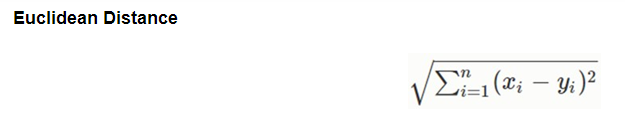
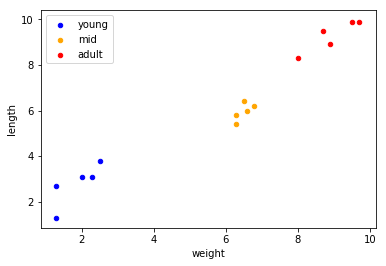
Measuring distance between 2 points (e.g. instances of different classes as on upper figure below).
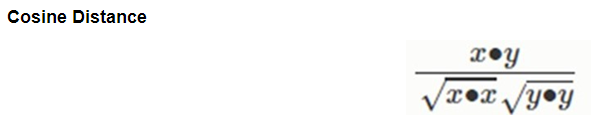
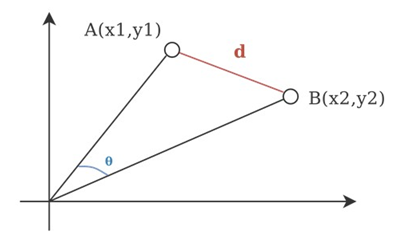
Measuring angle between two vectors & vector - magnitude doesn't matter (e.g. doc classification or sensor values at various lengths of time; see the other figure). Formula – ratio of dot product and cross product of vector lengths / magnitudes