01Tree Representation Implementation (Lists)
Source notebook: Tree Representation Implementation (Lists).ipynb
Tree Representation Implementation (Lists)
Below is a representation of a Tree using a list of lists. Refer to the video lecture for an explanation and a live coding demonstration!
def BinaryTree(r):
    return [r, [], []]

def insertLeft(root,newBranch):
    t = root.pop(1)
    if len(t) > 1:
        root.insert(1,[newBranch,t,[]])
    else:
        root.insert(1,[newBranch, [], []])
    return root

def insertRight(root,newBranch):
    t = root.pop(2)
    if len(t) > 1:
        root.insert(2,[newBranch,[],t])
    else:
        root.insert(2,[newBranch,[],[]])
    return root

def getRootVal(root):
    return root[0]

def setRootVal(root,newVal):
    root[0] = newVal

def getLeftChild(root):
    return root[1]

def getRightChild(root):
    return root[2]
02Tree Representation Implementation (Nodes and References)
Source notebook: Tree Representation Implementation (Nodes and References).ipynb
Nodes and References Implementation of a Tree
In this notebook is the code corresponding to the lecture for implementing the representation of a Tree as a class with nodes and references!
class BinaryTree(object):
    def __init__(self,rootObj):
        self.key = rootObj
        self.leftChild = None
        self.rightChild = None

    def insertLeft(self,newNode):
        if self.leftChild == None:
            self.leftChild = BinaryTree(newNode)
        else:
            t = BinaryTree(newNode)
            t.leftChild = self.leftChild
            self.leftChild = t

    def insertRight(self,newNode):
        if self.rightChild == None:
            self.rightChild = BinaryTree(newNode)
        else:
            t = BinaryTree(newNode)
            t.rightChild = self.rightChild
            self.rightChild = t


    def getRightChild(self):
        return self.rightChild

    def getLeftChild(self):
        return self.leftChild

    def setRootVal(self,obj):
        self.key = obj

    def getRootVal(self):
        return self.key
We can see some examples of creating a tree and assigning children. Note that some outputs are Trees themselves!
from __future__ import print_function

r = BinaryTree('a')
print(r.getRootVal())
print(r.getLeftChild())
r.insertLeft('b')
print(r.getLeftChild())
print(r.getLeftChild().getRootVal())
r.insertRight('c')
print(r.getRightChild())
print(r.getRightChild().getRootVal())
r.getRightChild().setRootVal('hello')
print(r.getRightChild().getRootVal())
a
None
<__main__.BinaryTree object at 0x104779c10>
b
<__main__.BinaryTree object at 0x103b42c50>
c
hello
03Binary Heap Implementation
Source notebook: Binary Heap Implementation.ipynb
Binary Heap Implementation
Here is the reference code for the Binary Heap Implementation. Make sure to refer to the video lecture for the full explanation!
Binary Heap Operations
The basic operations we will implement for our binary heap are as follows:
- BinaryHeap() creates a new, empty, binary heap.
- insert(k) adds a new item to the heap.
- findMin() returns the item with the minimum key value, leaving item in the heap.
- delMin() returns the item with the minimum key value, removing the item from the heap.
- isEmpty() returns true if the heap is empty, false otherwise.
- size() returns the number of items in the heap.
- buildHeap(list) builds a new heap from a list of keys.
class BinHeap:
    def __init__(self):
        self.heapList = [0]
        self.currentSize = 0


    def percUp(self,i):

        while i // 2 > 0:

            if self.heapList[i] < self.heapList[i // 2]:


                tmp = self.heapList[i // 2]
                self.heapList[i // 2] = self.heapList[i]
                self.heapList[i] = tmp
            i = i // 2

    def insert(self,k):

        self.heapList.append(k)
        self.currentSize = self.currentSize + 1
        self.percUp(self.currentSize)

    def percDown(self,i):

        while (i * 2) <= self.currentSize:

            mc = self.minChild(i)
            if self.heapList[i] > self.heapList[mc]:

                tmp = self.heapList[i]
                self.heapList[i] = self.heapList[mc]
                self.heapList[mc] = tmp
            i = mc

    def minChild(self,i):

        if i * 2 + 1 > self.currentSize:

            return i * 2
        else:

            if self.heapList[i*2] < self.heapList[i*2+1]:
                return i * 2
            else:
                return i * 2 + 1

    def delMin(self):
        retval = self.heapList[1]
        self.heapList[1] = self.heapList[self.currentSize]
        self.currentSize = self.currentSize - 1
        self.heapList.pop()
        self.percDown(1)
        return retval

    def buildHeap(self,alist):
        i = len(alist) // 2
        self.currentSize = len(alist)
        self.heapList = [0] + alist[:]
        while (i > 0):
            self.percDown(i)
            i = i - 1
04Binary Search Trees
Source notebook: Binary Search Trees.ipynb
Binary Search Trees
This is the code ot go along with the video explanation. Check out the video lecture for full details!
class TreeNode:

    def __init__(self,key,val,left=None,right=None,parent=None):
        self.key = key
        self.payload = val
        self.leftChild = left
        self.rightChild = right
        self.parent = parent

    def hasLeftChild(self):
        return self.leftChild

    def hasRightChild(self):
        return self.rightChild

    def isLeftChild(self):
        return self.parent and self.parent.leftChild == self

    def isRightChild(self):
        return self.parent and self.parent.rightChild == self

    def isRoot(self):
        return not self.parent

    def isLeaf(self):
        return not (self.rightChild or self.leftChild)

    def hasAnyChildren(self):
        return self.rightChild or self.leftChild

    def hasBothChildren(self):
        return self.rightChild and self.leftChild

    def replaceNodeData(self,key,value,lc,rc):
        self.key = key
        self.payload = value
        self.leftChild = lc
        self.rightChild = rc
        if self.hasLeftChild():
            self.leftChild.parent = self
        if self.hasRightChild():
            self.rightChild.parent = self


class BinarySearchTree:

    def __init__(self):
        self.root = None
        self.size = 0

    def length(self):
        return self.size

    def __len__(self):
        return self.size

    def put(self,key,val):
        if self.root:
            self._put(key,val,self.root)
        else:
            self.root = TreeNode(key,val)
        self.size = self.size + 1

    def _put(self,key,val,currentNode):
        if key < currentNode.key:
            if currentNode.hasLeftChild():
                   self._put(key,val,currentNode.leftChild)
            else:
                   currentNode.leftChild = TreeNode(key,val,parent=currentNode)
        else:
            if currentNode.hasRightChild():
                   self._put(key,val,currentNode.rightChild)
            else:
                   currentNode.rightChild = TreeNode(key,val,parent=currentNode)

    def __setitem__(self,k,v):
        self.put(k,v)

    def get(self,key):
        if self.root:
            res = self._get(key,self.root)
            if res:

                return res.payload
            else:
                return None
        else:
            return None

    def _get(self,key,currentNode):

        if not currentNode:
            return None
        elif currentNode.key == key:
            return currentNode
        elif key < currentNode.key:
            return self._get(key,currentNode.leftChild)
        else:
            return self._get(key,currentNode.rightChild)

    def __getitem__(self,key):
        return self.get(key)

    def __contains__(self,key):
        if self._get(key,self.root):
            return True
        else:
            return False

    def delete(self,key):

        if self.size > 1:

            nodeToRemove = self._get(key,self.root)
            if nodeToRemove:
                self.remove(nodeToRemove)
                self.size = self.size-1
            else:
                raise KeyError('Error, key not in tree')
        elif self.size == 1 and self.root.key == key:
            self.root = None
            self.size = self.size - 1
        else:
            raise KeyError('Error, key not in tree')

    def __delitem__(self,key):

        self.delete(key)

    def spliceOut(self):
        if self.isLeaf():
            if self.isLeftChild():

                self.parent.leftChild = None
            else:
                self.parent.rightChild = None
        elif self.hasAnyChildren():
            if self.hasLeftChild():

                if self.isLeftChild():

                    self.parent.leftChild = self.leftChild
                else:

                    self.parent.rightChild = self.leftChild
                    self.leftChild.parent = self.parent
        else:

            if self.isLeftChild():

                self.parent.leftChild = self.rightChild
            else:
                self.parent.rightChild = self.rightChild
                self.rightChild.parent = self.parent

    def findSuccessor(self):

        succ = None
        if self.hasRightChild():
            succ = self.rightChild.findMin()
        else:
            if self.parent:

                if self.isLeftChild():

                    succ = self.parent
                else:
                    self.parent.rightChild = None
                    succ = self.parent.findSuccessor()
                    self.parent.rightChild = self
        return succ

    def findMin(self):

        current = self
        while current.hasLeftChild():
            current = current.leftChild
        return current

    def remove(self,currentNode):

        if currentNode.isLeaf(): #leaf
            if currentNode == currentNode.parent.leftChild:
                currentNode.parent.leftChild = None
            else:
                currentNode.parent.rightChild = None
        elif currentNode.hasBothChildren(): #interior

            succ = currentNode.findSuccessor()
            succ.spliceOut()
            currentNode.key = succ.key
            currentNode.payload = succ.payload

        else: # this node has one child
            if currentNode.hasLeftChild():
                if currentNode.isLeftChild():
                    currentNode.leftChild.parent = currentNode.parent
                    currentNode.parent.leftChild = currentNode.leftChild
                elif currentNode.isRightChild():
                    currentNode.leftChild.parent = currentNode.parent
                    currentNode.parent.rightChild = currentNode.leftChild
                else:

                    currentNode.replaceNodeData(currentNode.leftChild.key,
                                    currentNode.leftChild.payload,
                                    currentNode.leftChild.leftChild,
                                    currentNode.leftChild.rightChild)
            else:

                if currentNode.isLeftChild():
                    currentNode.rightChild.parent = currentNode.parent
                    currentNode.parent.leftChild = currentNode.rightChild
                elif currentNode.isRightChild():
                    currentNode.rightChild.parent = currentNode.parent
                    currentNode.parent.rightChild = currentNode.rightChild
                else:
                    currentNode.replaceNodeData(currentNode.rightChild.key,
                                    currentNode.rightChild.payload,
                                    currentNode.rightChild.leftChild,
                                    currentNode.rightChild.rightChild)
mytree = BinarySearchTree()
mytree[3]="red"
mytree[4]="blue"
mytree[6]="yellow"
mytree[2]="at"

print(mytree[6])
print(mytree[2])
yellow
at
** Check the video for full explanation! **
05Binary Search Tree Check
Source notebook: Binary Search Tree Check - SOLUTION.ipynb
Binary Search Tree Check - SOLUTION
Problem Statement
Given a binary tree, check whether it’s a binary search tree or not.
** Again, no solution cell, just worry about your code making sense logically. Hint: Think about tree traversals. **
Solution
Here is a simple solution- If a tree is a binary search tree, then traversing the tree inorder should lead to sorted order of the values in the tree. So, we can perform an inorder traversal and check whether the node values are sorted or not.
tree_vals = []

def inorder(tree):
    if tree != None:
        inorder(tree.getLeftChild())
        tree_vals.append(tree.getRootVal())
        inorder(tree.getRightChild())

def sort_check(tree_vals):
    return tree_vals == sorted(tree_vals)

inorder(tree)
sort_check(tree_vals)
True
Another classic solution is to keep track of the minimum and maximum values a node can take. And at each node we will check whether its value is between the min and max values it’s allowed to take. The root can take any value between negative infinity and positive infinity. At any node, its left child should be smaller than or equal than its own value, and similarly the right child should be larger than or equal to. So during recursion, we send the current value as the new max to our left child and send the min as it is without changing. And to the right child, we send the current value as the new min and send the max without changing.
class Node:
    def __init__(self, k, val):
        self.key = k
        self.value = val
        self.left = None
        self.right = None

def tree_max(node):
    if not node:
        return float("-inf")
    maxleft  = tree_max(node.left)
    maxright = tree_max(node.right)
    return max(node.key, maxleft, maxright)

def tree_min(node):
    if not node:
        return float("inf")
    minleft  = tree_min(node.left)
    minright = tree_min(node.right)
    return min(node.key, minleft, minright)

def verify(node):
    if not node:
        return True
    if (tree_max(node.left) <= node.key <= tree_min(node.right) and
        verify(node.left) and verify(node.right)):
        return True
    else:
        return False

root= Node(10, "Hello")
root.left = Node(5, "Five")
root.right= Node(30, "Thirty")

print(verify(root)) # prints True, since this tree is valid

root = Node(10, "Ten")
root.right = Node(20, "Twenty")
root.left = Node(5, "Five")
root.left.right = Node(15, "Fifteen")

print(verify(root)) # prints False, since 15 is to the left of 10
True
False
This is a classic interview problem, so feel free to just Google search "Validate BST" for more information on this problem!
Good Job!
06Tree Level Order Print
Source notebook: Tree Level Order Print - SOLUTION.ipynb
Tree Level Order Print - SOLUTION
Given a binary tree of integers, print it in level order. The output will contain space between the numbers in the same level, and new line between different levels. For example, if the tree is:
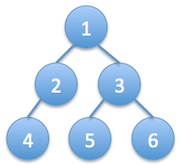
The output should be:
1
2 3
4 5 6
Solution
It won’t be practical to solve this problem using recursion, because recursion is similar to depth first search, but what we need here is breadth first search. So we will use a queue as we did previously in breadth first search. First, we’ll push the root node into the queue. Then we start a while loop with the condition queue not being empty. Then, at each iteration we pop a node from the beginning of the queue and push its children to the end of the queue. Once we pop a node we print its value and space.
To print the new line in correct place we should count the number of nodes at each level. We will have 2 counts, namely current level count and next level count. Current level count indicates how many nodes should be printed at this level before printing a new line. We decrement it every time we pop an element from the queue and print it. Once the current level count reaches zero we print a new line. Next level count contains the number of nodes in the next level, which will become the current level count after printing a new line. We count the number of nodes in the next level by counting the number of children of the nodes in the current level. Understanding the code is easier than its explanation:
class Node:
    def __init__(self, val=None):
        self.left = None
        self.right = None
        self.val =  val
def levelOrderPrint(tree):
    if not tree:
        return
    nodes=collections.deque([tree])
    currentCount, nextCount = 1, 0
    while len(nodes)!=0:
        currentNode=nodes.popleft()
        currentCount-=1
        print currentNode.val,
        if currentNode.left:
            nodes.append(currentNode.left)
            nextCount+=1
        if currentNode.right:
            nodes.append(currentNode.right)
            nextCount+=1
        if currentCount==0:
            #finished printing current level
            print '\n',
            currentCount, nextCount = nextCount, currentCount
The time complexity of this solution is O(N), which is the number of nodes in the tree, so it’s optimal. Because we should visit each node at least once. The space complexity depends on maximum size of the queue at any point, which is the most number of nodes at one level. The worst case occurs when the tree is a complete binary tree, which means each level is completely filled with maximum number of nodes possible. In this case, the most number of nodes appear at the last level, which is (N+1)/2 where N is the total number of nodes. So the space complexity is also O(N). Which is also optimal while using a queue.
Again, this is a very common tree interview question!
Good Job!
07Trim a Binary Search Tree
Source notebook: Trim a Binary Search Tree - SOLUTION.ipynb
Trim a Binary Search Tree - SOLUTION
Problem Statement
Given the root of a binary search tree and 2 numbers min and max, trim the tree such that all the numbers in the new tree are between min and max (inclusive). The resulting tree should still be a valid binary search tree. So, if we get this tree as input:
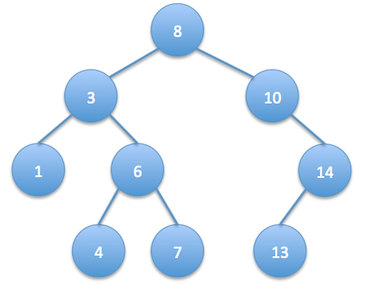
and we’re given min value as 5 and max value as 13, then the resulting binary search tree should be:
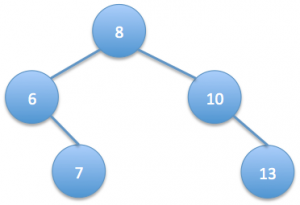
We should remove all the nodes whose value is not between min and max.
Solution
We can do this by performing a post-order traversal of the tree. We first process the left children, then right children, and finally the node itself. So we form the new tree bottom up, starting from the leaves towards the root. As a result while processing the node itself, both its left and right subtrees are valid trimmed binary search trees (may be NULL as well).
At each node we’ll return a reference based on its value, which will then be assigned to its parent’s left or right child pointer, depending on whether the current node is left or right child of the parent. If current node’s value is between min and max (min<=node<=max) then there’s no action need to be taken, so we return the reference to the node itself. If current node’s value is less than min, then we return the reference to its right subtree, and discard the left subtree. Because if a node’s value is less than min, then its left children are definitely less than min since this is a binary search tree. But its right children may or may not be less than min we can’t be sure, so we return the reference to it. Since we’re performing bottom-up post-order traversal, its right subtree is already a trimmed valid binary search tree (possibly NULL), and left subtree is definitely NULL because those nodes were surely less than min and they were eliminated during the post-order traversal. Remember that in post-order traversal we first process all the children of a node, and then finally the node itself.
Similar situation occurs when node’s value is greater than max, we now return the reference to its left subtree. Because if a node’s value is greater than max, then its right children are definitely greater than max. But its left children may or may not be greater than max. So we discard the right subtree and return the reference to the already valid left subtree. The code is easier to understand:
def trimBST(tree, minVal, maxVal):

    if not tree:
        return

    tree.left=trimBST(tree.left, minVal, maxVal)
    tree.right=trimBST(tree.right, minVal, maxVal)

    if minVal<=tree.val<=maxVal:
        return tree

    if tree.val<minVal:
        return tree.right

    if tree.val>maxVal:
        return tree.left
The complexity of this algorithm is O(N), where N is the number of nodes in the tree. Because we basically perform a post-order traversal of the tree, visiting each and every node one. This is optimal because we should visit every node at least once. This is a very elegant question that demonstrates the effectiveness of recursion in trees.