NP Completeness
Traveling Salesman Problem (TSP)
Famous NP hard problem. There is no known polynomial time solution.
Given a set of cities and distance between every pair of cities, find the shortest possible route to visit every city exactly once and return to the starting point.
Different from the Hamiltonian cycle problem: find if there exist a tour that visits every city exactly once. Here we know that Hamiltonian Tour exists (graph is complete) and in fact many such tours exist, the problem is to find a minimum weight Hamiltonian cycle.
For example, consider the graph shown in figure. A TSP tour in the graph is 1-2-4-3-1. The cost of the tour is 10+25+30+15 which is 80.
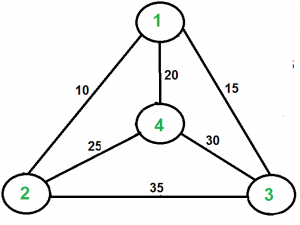
Factorial / combinatorial time solution: * Any point can be starting, select one and generate all (n-1)! permutations of cities. * Calculate cost of every permutation & return the permutation with minimum cost
# Naive approach
from sys import maxsize
V = 4

def travellingSalesmanProblem(graph, s):

    vertices = []                                          # store all verteces, but source vertex
    for i in range(V):
        if i != s:
            vertices.append(i)

    min_pathweight = maxsize                               # store min weight Hamiltonian Cycle

    while True:

        current_pathweight = 0                             # store current Path weight(cost)

        k = s                                              # compute current path weight
        for i in range(len(vertices)):
            current_pathweight += graph[k][vertices[i]]
            k = vertices[i]
        current_pathweight += graph[k][s]

        min_pathweight = min(min_pathweight, current_pathweight)       # update minimum

        if not next_permutation(vertices):
            break

    return min_pathweight


def next_permutation(L):

    n = len(L)

    i = n - 2
    while i >= 0 and L[i] >= L[i + 1]:
        i -= 1

    if i == -1:
        return False

    j = i + 1
    while j < n and L[j] > L[i]:
        j += 1
    j -= 1

    L[i], L[j] = L[j], L[i]

    left = i + 1
    right = n - 1

    while left < right:
        L[left], L[right] = L[right], L[left]
        left += 1
        right -= 1

    return True

# Driver Code
if __name__ == "__main__":

    # matrix representation of graph
    graph = [[0, 10, 15, 20], [10, 0, 35, 25],
             [15, 35, 0, 30], [20, 25, 30, 0]]
    s = 0
    print(travellingSalesmanProblem(graph, s))
80
# Dynamic approach: https://towardsdatascience.com/solving-tsp-using-dynamic-programming-2c77da86610d
def DP_TSP(distances_array):
    n = len(distances_array)
    all_points_set = set(range(n))

    # memo keys: tuple(sorted_points_in_path, last_point_in_path)
    # memo values: tuple(cost_thus_far, next_to_last_point_in_path)
    memo = {(tuple([i]), i): tuple([0, None]) for i in range(n)}
    queue = [(tuple([i]), i) for i in range(n)]

    while queue:
        prev_visited, prev_last_point = queue.pop(0)
        prev_dist, _ = memo[(prev_visited, prev_last_point)]

        to_visit = all_points_set.difference(set(prev_visited))
        for new_last_point in to_visit:
            new_visited = tuple(sorted(list(prev_visited) + [new_last_point]))
            new_dist = prev_dist + distances_array[prev_last_point][new_last_point]

            if (new_visited, new_last_point) not in memo:
                memo[(new_visited, new_last_point)] = (new_dist, prev_last_point)
                queue += [(new_visited, new_last_point)]
            else:
                if new_dist < memo[(new_visited, new_last_point)][0]:
                    memo[(new_visited, new_last_point)] = (new_dist, prev_last_point)

    optimal_path, optimal_cost = retrace_optimal_path(memo, n)

    return optimal_path, optimal_cost
def retrace_optimal_path(memo: dict, n: int) -> [[int], float]:
    points_to_retrace = tuple(range(n))

    full_path_memo = dict((k, v) for k, v in memo.items() if k[0] == points_to_retrace)
    path_key = min(full_path_memo.keys(), key=lambda x: full_path_memo[x][0])

    last_point = path_key[1]
    optimal_cost, next_to_last_point = memo[path_key]

    optimal_path = [last_point]
    points_to_retrace = tuple(sorted(set(points_to_retrace).difference({last_point})))

    while next_to_last_point is not None:
        last_point = next_to_last_point
        path_key = (points_to_retrace, last_point)
        _, next_to_last_point = memo[path_key]

        optimal_path = [last_point] + optimal_path
        points_to_retrace = tuple(sorted(set(points_to_retrace).difference({last_point})))

    return optimal_path, optimal_cost
import numpy as np

n = 5
X = np.random.rand(n, 2)
distances_array = np.array([[np.linalg.norm(X[i] - X[j])
                                 for i in range(n)]
                                for j in range(n)])
DP_TSP(distances_array)
([0, 2, 4, 1, 3], 1.6341422030275194)
NP complete
An NP-complete problem cannot be solved in polynomial time. NP-Hard/NP-Complete - classes of problems are not solvable in realistic time.
There are often approximate solutions for NP-Complete problems (approximation bound tells us how close the approximation is).
NP = Non-deterministic Polynomial time A set of all decision problems for which the answers can be verified in polynomial time (O(n**k) by a deterministic Turing machine.
P Set of all decision problems which can be solved in polynomial time by a deterministic Turing machine. Since they can be solved in polynomial time, they can also be verified in polynomial time => P is a subset of NP.
NP-Complete A problem x from NP is also in NP-Complete iff every other problem in NP can be quickly (polynomial time) transformed into x. In other words, __x is in NP, and every problem in NP is reducible to x in polynomial time_
If any NP-Complete problem is solved quickly => all NP problems can be solved quickly
NP-Hard At least as hard as NP => all NP problems can be reduced (in polynomial time) to them. NP-Complete p. are also NP-hard, but NP-hard p. need not be in NP => need not have solutions verifiable in polynomial time (NP in NP-hard does not mean non-deterministic polynomial time!)
TSP = NP-hard; the decision version of TSP (decide whether the graph has a tour of at most L) = NP-complete
A problem is NP-hard if any problem in NP can be reduced to it in polynomial time. A problem is NP-complete if any problem in NP can be reduced to it in polynomial time AND it is also in NP (and thus solutions can be verified in polynomial time)
P = NP? is a one-million dollar question
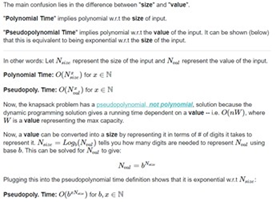
Dynamic programming may provide a polynomial solution, but when the numbers are given as binary numbers (in the size of the input, i.e. the number of bits in the input), the dynamic programming will take exponentially many steps to finish => the knapsack problem is NP-complete or pseudopolynomial
Knapsack
Given two integer arrays values[n-1] and weights[n-1] and an integer W = knapsack capacity. For subsets with weights <= W (cannot break an item), find the subset with max value
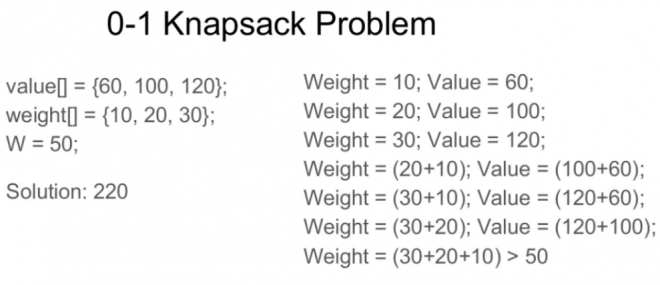
Naive solution:
Consider only subsets w/total weight < W; from them, pick the max value subset
Max value from n items is max of:
* Max value obtained with n-1 items and W (excluding nth item).
* Value of nth item plus maximum value obtained with n-1 items and W - weight of nth item (including nth item).
If weight of nth item > W => nth item cannot be included and Case 1 is the only possibility
# a naive recursive implementation; time c. O(2^n), space c. O(1)
def knapsack(W, wt, val, n):

    if n == 0 or W == 0:                                                    # base case
        return 0

    if wt[n-1] > W:                                                         # if weight of the nth item > W, exclude nth item
        return knapsack(W, wt, val, n-1)

    # return the maximum of two cases:
    # (1) nth item included, (2) not included
    else:
        return max( val[n-1] + knapsack( W-wt[n-1], wt, val, n-1),  knapsack(W, wt, val, n-1))

val = [60, 100, 120]
wt = [10, 20, 30]
W = 50
length_val = len(val)
print(knapsack(W, wt, val, length_val))
220
DP Solution:
Like for other DP solutions, avoid recomputations of same subproblems by constructing temp array K[][] in bottom-up manner
DP[][] table: columns = all possible weights 1 - W, rows = weights that can be kept.
State DP[i][j] = max value of j-weight considering all values 1 - i. If wi = weight in ith row, it can be filled for all columns w/weight values > wi. Two possibilities:
* fill wi in the given column
* don't fill wi in the given column
based on max of these two possibilities (if not fill ith weight in jth column => DP[i][j] state = DP[i-1][j] state, but if fill => DP[i][j] state = wi + value of the column weighing j-wi in the previous row)
# DP solution (memoization?)
# O(N*W) time and space
def knapSack(W, weights, values, n):
    DP = [[0 for x in range(W + 1)] for x in range(n + 1)]

    # Build table DP[][] in bottom up manner
    for i in range(n + 1):
        for w in range(W + 1):
            if i == 0 or w == 0:
                DP[i][w] = 0
            elif weights[i-1] <= w:
                DP[i][w] = max(values[i-1] + DP[i-1][w - weights[i-1]],  DP[i-1][w])
            else:
                DP[i][w] = DP[i-1][w]

    return DP[n][W]

values = [60, 100, 120]
weights = [10, 20, 30]
W = 50
print(knapSack(W, weights, values, len(values)))
220
Memoization solution (extension of recursive approach)
Extension of recursive approach to overcome recalculations of the same cases - create 2D array storing a particular state (n, w) - now if we get it again, we can use the stored results (constant time) instead of recalculating
# Recursion + memoization solution
# returns max value to fit in knapsack of capacity W
# O(N*W) time and space
def knapsack(weights, values, W, length):

    # base conditions
    if length == 0 or W == 0:
        return 0
    if DP[length][W] != -1:
        return DP[length][W]

    # choice diagram code
    if wt[length - 1] <= W:
        DP[length][W] = max( values[length-1] + knapsack( weights, values, W - wt[length-1], length-1),
                            knapsack(weights, values, W, length - 1))
        return DP[length][W]
    elif wt[length - 1] > W:
        DP[length][W] = knapsack(weights, values, W, length-1)
        return DP[length][W]


values = [60, 100, 120]
weights = [10, 20, 30]
W = 50
length = len(val)

# initialize the matrix with -1 at first
DP = [[-1 for i in range(W + 1)] for j in range(length + 1)]

print(knapsack(weights, values, W, length))
220
Coin change (knapsack variant)
Classic recursion problem: target amount n + array of distinct coins => fewest coins to make the change Example: if n = 10 and coins = [1,5,10]. Then there are 4 possible ways to make change: * 1+1+1+1+1+1+1+1+1+1 * 5 + 1+1+1+1+1 * 5+5 * 10
Recursion is not optimal - each node = recursion call; label on node - amount of change composed of coins. We are recalculating values we've already solved! 15 is called 3 times. Much better to keep track of function calls
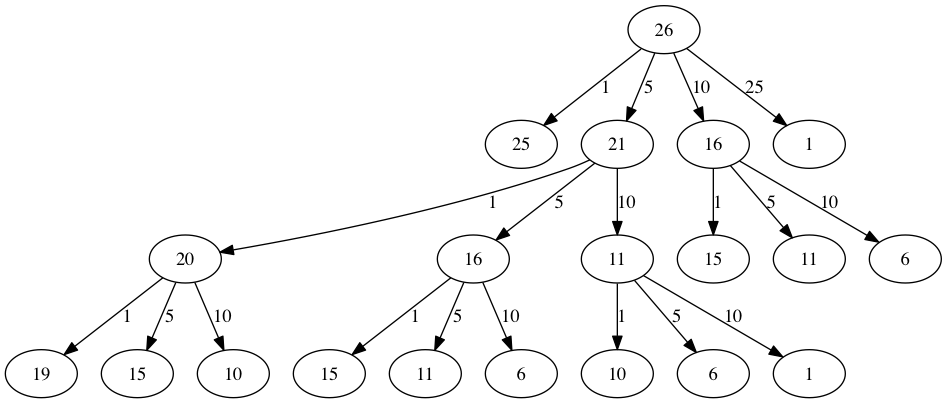 "Dynamic" solution reduces calls - storing results for min # coins in table => before computing new min, we check table if min is already known. This is no really dynamic, but an improvement of the recursive call using "memoization" otherwise known as "caching."
More here: Dynamic Programming Coin Change Problem
# recursive, non-optimized
def rec_coin(target, coins):
    '''
    Target: change amount
    Coins: list of coin values
    '''

    min_coins = target                                    # default to target value
    if target in coins:                                   # base case - check if we have a single coin match
        return 1

    else:
        for i in [c for c in coins if c <= target]:       # for each coin value <= target
            num_coins = 1 + rec_coin(target-i,coins)      # recursive call

            if num_coins < min_coins:                     # reset min if we have new min
                min_coins = num_coins

    return min_coins
rec_coin(63,[1,5,10,25])
6
# using memoization or caching
def rec_coin_dynam(target, coins, known_results):
    '''
    Target: change amount
    Coins: list of coin values
    Known_results: previous results
    '''

    min_coins = target                                      # default to target value

    if target in coins:                                     # base case 1 - check if we have a single coin match
        known_results[target] = 1
        return 1
    elif known_results[target] > 0:                         # base case 2 - if this value was already calculated before
        return known_results[target]

    else:
        for i in [c for c in coins if c <= target]:
            num_coins = 1 + rec_coin_dynam(target-i, coins, known_results)

            if num_coins < min_coins:
                min_coins = num_coins                       # reset min if we have new min
                known_results[target] = min_coins           # reset the known result

    return min_coins
target = 74
coins = [1,5,10,25]
known_results = [0]*(target+1)        #why?

rec_coin_dynam(target, coins, known_results)
# dynamic solution explained at https://runestone.academy/runestone/books/published/pythonds/Recursion/DynamicProgramming.html
def coin_dynam(coinValueList, change, minCoins, coinsUsed):
    for cents in range(change+1):
        coinCount = cents
        newCoin = 1
        for j in [c for c in coinValueList if c <= cents]:
            if minCoins[cents-j] + 1 < coinCount:
                coinCount = minCoins[cents-j]+1
                newCoin = j
        minCoins[cents] = coinCount
        coinsUsed[cents] = newCoin
    return minCoins[change]

def printCoins(coinsUsed, change):
    coin = change
    while coin > 0:
        thisCoin = coinsUsed[coin]
        print(thisCoin, end=', ')
        coin = coin - thisCoin
amnt = 63
coin_list = [1,5,10,21,25]
coinsUsed = [0]*(amnt+1)
coinCount = [0]*(amnt+1)

print("Making change for",amnt,"requires")
print(coin_dynam(coin_list, amnt, coinCount, coinsUsed), "coins")
print("They are:")
printCoins(coinsUsed, amnt)
print("\nThe used list is as follows:")
print(coinsUsed)
Another dynamic solution is provided on the dedicated Wikipedia page
Number of ways to cover a distance
Given a distance, count total number of ways to cover the distance with 1, 2 and 3 steps.
Examples:
Distance = 3
Output: 4
Explantion:
Below are the four ways
1 step + 1 step + 1 step
1 step + 2 step
2 step + 1 step
3 step
Distance = 4
Output: 7
Explantion:
Below are the four ways
1 step + 1 step + 1 step + 1 step
1 step + 2 step + 1 step
2 step + 1 step + 1 step
1 step + 1 step + 2 step
2 step + 2 step
3 step + 1 step
1 step + 3 step
Time c. O(n). Space c. O(n)
Algorithm * Create an array of size n + 1 and initilize the first 3 variables with 1, 1, 2. The base cases. * Run a loop from 3 to n. * For each index i, computer value of ith position as dp[i] = dp[i-1] + dp[i-2] + dp[i-3]. * Print the value of dp[n], as the Count of number of ways to cover a distance.
def printCountDP(dist):
    count = [0] * (dist + 1)

    # Initialize base values - one way to cover 0 and 1 distances; two ways to cover 2 distance
    count[0] = 1
    count[1] = 1
    count[2] = 2

    # Fill the count array in bottom up manner
    for i in range(3, dist + 1):
        count[i] = (count[i-1] + count[i-2] + count[i-3])

    return count[dist];


dist = 100
print( printCountDP(dist))
180396380815100901214157639
Recursion
# example - factorial
def fact(n):
    '''
    Returns n!
    '''
    if n == 0:                   # BASE CASE!
        return 1
    else:                        # Recursion!
        return n * fact(n-1)

fact(5)
120
# example - sum from 0 to n
def rec_sum(n):

    if n == 0:                    # Base Case
        return 0
    else:                         # Recursion
        return n + rec_sum(n-1)

rec_sum(100)
# example - sum of all indiv digits of n
def sum_func(n):

    if len(str(n)) == 1:                  # Base case
        return n
    else:                                 # Recursion
        return n%10 + sum_func(n//10)

sum_func(4321)
# example - split a phrase into words
def word_split(phrase, list_of_words, output=None):
    '''
    Parameters:
        phrase: string phrase
        list_of_words: list of words
    Returns:
        string split with words from list_of_words
    '''

    # Checks if output initiated; if default output=[], it will be overwritten in every recursion!
    if output is None:
        output = []

    for word in list_of_words:

        if phrase.startswith(word):
            output.append(word)
            return word_split(phrase[len(word):], list_of_words, output)        # recursion - pass along the output

    # return output if no phrase.startswith(word) is True
    return output
print(word_split('themanran',['the','ran','man']))
print(word_split('ilovedogsJohn',['i','am','a','dogs','lover','love','John']))
print(word_split('themanran',['clown','ran','man']))
['the', 'man', 'ran']
['i', 'love', 'dogs', 'John']
[]
Memoization
Wikipedia article on Memoization, before continuing on with this lecture! Memoization = memo / to be remembered, returns remembered results not to compute again. It's like a cache for method results. It can be an improved versions of a recursive solution.
# Create cache for known results
def factorial(n):
    if n < 2:
        return 1
    if not n in memo:
        memo[n] = n*factorial(n-1)
    return memo[n]

memo = {}
factorial(5)
120
dict stores previous results => increased efficiency
Memoization encapsulated as a class:
class Memoize:
    def __init__(self, f):
        self.f = f
        self.memo = {}
    def __call__(self, *args):
        if not args in self.memo:
            self.memo[args] = self.f(*args)
        return self.memo[args]
def factorial(n):
    if n < 2:
        return 1
    return n * factorial(n-1)

factorial = Memoize(factorial)
factorial(5)
Fibonnaci Sequence in three ways:
- Recursively
- Dynamically (Memoization to store results)
- Iteratively
Fibonacci sequence: 0,1,1,2,3,5,8,13,21,... starts with base case of checking if n=0 or 1 => returns 1; else return fib(n-1)+fib(n+2)
# recursive - exponential time O(2^n)
def fib_rec(n):
    if n == 0 or n == 1:                                # basea case
        return n
    else:
        return fib_rec(n-1) + fib_rec(n-2)
for i in range(40):
    print(fib_rec(i), end=', ')
0, 1, 1, 2, 3, 5, 8, 13, 21, 34, 55, 89, 144, 233, 377, 610, 987, 1597, 2584, 4181, 6765, 10946, 17711, 28657, 46368, 75025, 121393, 196418, 317811, 514229, 832040, 1346269, 2178309, 3524578, 5702887, 9227465, 14930352, 24157817, 39088169, 63245986,
# dynamic - cache is set beforehand based on n
# checking if cache[n] != None means checking to know if we should keep setting cache (keep cache of old results!)
def fib_dyn(n):

    if n == 0 or n == 1:                             # base case
        return n

    if cache[n] != None:                             # check cache
        return cache[n]

    cache[n] = fib_dyn(n-1) + fib_dyn(n-2)           # keep setting cache

    return cache[n]
# instantiate cache
for i in range(40):
    n = i
    cache = [None] * (n + 1)

    print(fib_dyn(n), end=', ')
0, 1, 1, 2, 3, 5, 8, 13, 21, 34, 55, 89, 144, 233, 377, 610, 987, 1597, 2584, 4181, 6765, 10946, 17711, 28657, 46368, 75025, 121393, 196418, 317811, 514229, 832040, 1346269, 2178309, 3524578, 5702887, 9227465, 14930352, 24157817, 39088169, 63245986,
# iterative - tuple unpacking!
def fib_iter(n):

    a = 0
    b = 1

    for i in range(n):
        a, b = b, a + b

    return a
for i in range(40):
    print(fib_iter(i), end=', ')
0, 1, 1, 2, 3, 5, 8, 13, 21, 34, 55, 89, 144, 233, 377, 610, 987, 1597, 2584, 4181, 6765, 10946, 17711, 28657, 46368, 75025, 121393, 196418, 317811, 514229, 832040, 1346269, 2178309, 3524578, 5702887, 9227465, 14930352, 24157817, 39088169, 63245986,