- DATA STRUCTURES
- BIG O NOTATION
- Big O Examples
- O(1) Constant
- O(n) Linear
- O(log n) Logarithmic time
- O(n log n) Loglinear or linearithmic time
- O(n^2) Quadratic
- O(n**a) Polynomial Time Generalized
- O(n!) Factorial or combinatorial complexity
- Calculating Scale of Big-O
- Worst Case vs Best Case
- Space Complexity
- Singly Linked List
- Doubly Linked List (DLL)
- LL manipulations
- Queue
- Dequeue
- Stack
- 20. Balanced parenthesis check (stack)
- Queue with two stacks
- Stack using two queues
- Two stacks in an array (space efficient)
- Next Greater Element with Stack Implementation ((O(n))
- Bitwise operators
- Number Theory (Geeksforgeeks)
- Appendix (disregard)
DATA STRUCTURES
Trees and Graphs are covered in a separate notebook.
This link contains a lot more algorithms to review before the interview, especially those I haven't reviewed yet - DP, number theory, bit manipulation, some interesting string / array algos!
BIG O NOTATION
Big Omega - lower bound (best case); Big Theta - average bound; Big O - max bound
Big-O notation describes how quickly runtime will grow relative to the input as the input gets arbitrarily large. Big-O notation is a relative representation of the complexity of an algorithm
- relative: you can't compare multiplication to sorting directly, but comparison of two sorts is meaningful;
- representation: Big-O reduces comparison to single var through observations or assumptions, e.g. sorting is compared on comparison operations (expensive)
- complexity: one second to sort 10,000 elements, how long to sort one million? Complexity = relative measure to something else.
- We compare how quickly runtime grows, not exact runtimes (can vary depending on hardware).
- We compare for a variety of input sizes - relative to the input => use n for notation.
- We only worry about terms that grow the fastest as n gets large => Big-O is asymptotic analysis
Asymptotic behavior = limiting behavior (theory of limits). Asymptote (/ˈæsɪmptoʊt/) of a curve is a line such that the distance between the curve and the line approaches zero as one or both x or y tends to infinity
THEORY
Order of magnitude
Time complexity != exact # times the code runs, but shows the order of magnitude. E.g. if the code is executed 3n, n+5 and n/2 times, time complexity is the same = O(n)
Phases
If algo has consecutive phases, total time complexity = time complexity of the largest single phase.
Reason - slowest phase is usually the bottleneck. E.g. if the code consists of three phases O(1), O(n), and O(n^2) => total time complexity = O(n^2)
Several variables
Sometimes time complexity depends on several factors. If two nested loops, 1 through n & 1 through m, time complexity = O(nm):
for (int i = 1; i <= n; i++) {
for (int j = 1; j <= m; j++) {// code}
}
Recursion
Time complexity of recursive f(x) = # calls X time complexity of each call
For example - n function calls, each w/complexity of O(1) = total time complexity of O(n):
void f(int n) {
if (n == 1) return;
f(n-1);
}
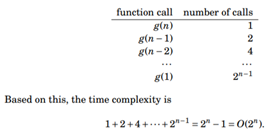
Another example:
void g(int n) {
if (n == 1) return;
g(n-1);
g(n-1);
}
Each call generates two more calls, except for n = 1:
| Big-O | Name |
|---|---|
| 1 | Constant |
| log(n) | Logarithmic |
| n | Linear |
| nlog(n) | Log Linear |
| n^2 | Quadratic |
| n^3 | Cubic |
| 2^n | Exponential |
Complexity classes
From "Competitive Programmer’s Handbook" - very interesting book: terse and to the point
- O(1) constant-time algo - no dependency on input size. E.g. formula calculating an answer OR list[idx].
- O(logn) algo halves / reduces input size at each step. Logarithmic because (log2 n) = # times to divide n by 2 to get 1.
- O(sqrt(n)) slower than O(logn), but faster than O(n); sqrt(n) = sqrt(n) / n, so sqrt(n) lies in the middle of input.
- O(n) iteration over the input - accessing each input element at least once before reporting the answer.
- O(nlogn) often indicates that algo sorts the input OR algo uses data structure where each operation takes O(logn) time.
- O(n^2) two nested loops
- O(n^3) three nested loops.
- O(2^n) algo iterates through all subsets of input elements. E.g. subsets of {1,2,3}: {1}, {2}, {3}, {1,2}, {1,3}, {2,3} and {1,2,3}.
- O(n!) algo iterates through all permutations of input elements. E.g. permutations of {1,2,3}: (1,2,3), (1,3,2), (2,1,3), (2,3,1), (3,1,2) and (3,2,1). Polynomial algo - time complexity of O(n^k) where k is const; if k small - algo efficient. All above except O(2^n) and O(n!) are polynomial.
There are many important problems with no known polynomial (=efficient) algo, e.g. NP-hard problems
from math import log
import numpy as np
import matplotlib.pyplot as plt
%matplotlib inline
plt.style.use('bmh')

# Set up runtime comparisons
n = np.linspace(1,10,1000)
labels = ['Constant','Logarithmic','Linear','Log Linear','Quadratic','Cubic','Exponential']
big_o = [np.ones(n.shape),np.log(n),n,n*np.log(n),n**2,n**3,2**n]

# Plot setup
plt.figure(figsize=(10,8))
plt.ylim(0,50)

for i in range(len(big_o)):
    plt.plot(n,big_o[i],label = labels[i])


plt.legend(loc=0)
plt.ylabel('Relative Runtime')
plt.xlabel('n')
Text(0.5, 0, 'n')
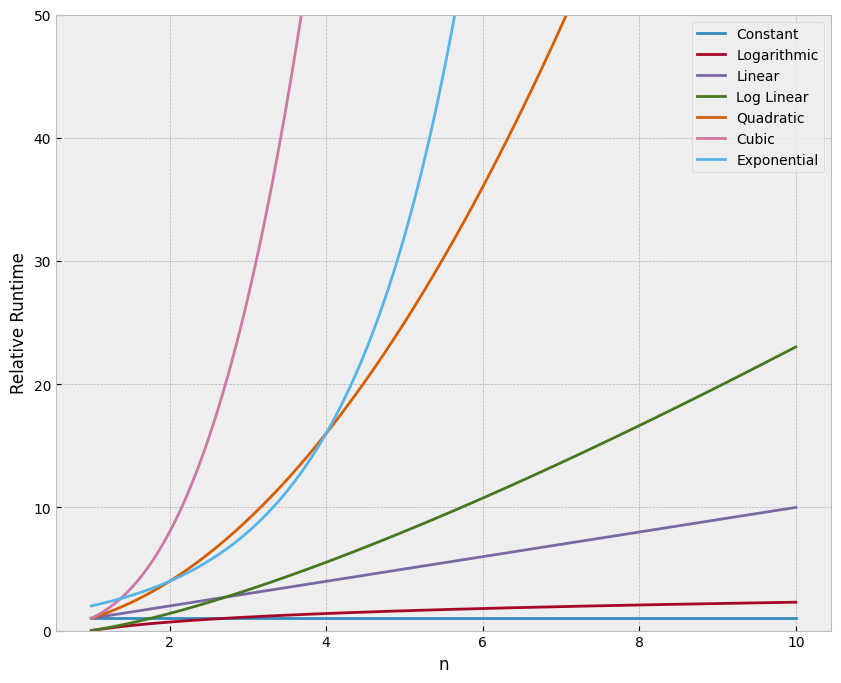
Stay away from any exponential, quadratic, or cubic behavior!
Lists
Common list operations and their Big O values:
| Operation | Big-O Efficiency |
|---|---|
| index [] | O(1) |
| index assignment | O(1) |
| append | O(1) |
| pop() | O(1) |
| pop(i) | O(n) |
| insert(i,item) | O(n) |
| del operator | O(n) |
| iteration | O(n) |
| contains (in) | O(n) |
| get slice [x:y] | O(k) |
| del slice | O(n) |
| set slice | O(n+k) |
| reverse | O(n) |
| concatenate | O(k) |
| sort | O(n log n) |
| multiply | O(nk) |
Dictionaries
Use hash tables - get and set items = O(1)! (Hash tables - one of the most important data structures). Common dictionary operations:
| Operation | Big-O Efficiency |
|---|---|
| copy | O(n) |
| iteration | O(n) |
| get item | O(1) |
| set item | O(1) |
| delete item | O(1) |
| contains (in) | O(1) |
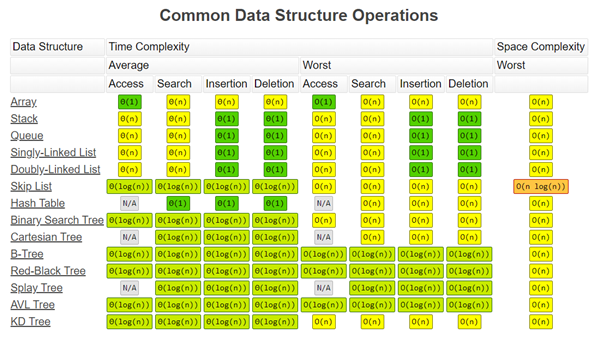
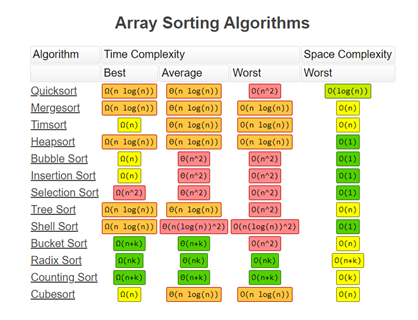
Big-O Cheatsheet
Big O Examples
O(1) Constant
def func_constant(values):
    '''
    Prints first item in a list of values.
    '''
    print values[0]

func_constant([1,2,3])
For any list, get 1 value list[index] and print it regardless of the list size
O(n) Linear
def func_lin(lst):
    '''
    Takes in list and prints out all values
    '''
    for val in lst:
        print(val, end=' ')

func_lin([1,2,3])
O(n) (linear time) - number of operations scales linearly with n (list of 100 values will print 100 times, a list of 10,000 values will print 10,000 times, and a list of n values will print n times).
O(log n) Logarithmic time
Algorithm often halves the input size at each step. Running time = logarithmic, because log2 n = # times n must be divided by 2 to get 1.
Running time grows in proportion to the logarithm of the input size - more elements during less time, proportional to the number of digits in n. Find a name in the phone book - divide-and-conquer by looking based on where the name is alphabetically. Any d&q is logarithmic time.
Common attributes of log f(x):
* Choice of the next element on which to perform some action - one of several AND only one will be picked
or
* elements on which the action is performed are digits of n
O(n log n) Loglinear or linearithmic time
Logarithmic f(x) run n times e.g. reducing the size of a list n times (mergesort). If outer loop iterates through a list O(n), and an inner loop is cutting/reducing data on each iteration O(log n) => overall complexity is O(n log n)
O(n^2) Quadratic
def func_quad(lst):
    '''
    Prints pairs for every item in list.
    '''
    for item_1 in lst:
        for item_2 in lst:
            print(item_1, item_2, end=', ')

lst = [0, 1, 2, 3]

func_quad(lst)
Two nested loops - list of n items will perform n x n operations (n^2)
If there are k nested loops, it's O(n^k)
O(n**a) Polynomial Time Generalized
O(n), O(n2) etc. are all polynomial time. Some problems cannot be solved in polynomial time: Public Key Cryptography - computationally hard to find two prime factors of a very large number
O(n!) Factorial or combinatorial complexity
The Traveling Salesman
There are n towns, each linked to 1 or more other towns by a road of a certain distance. Find the shortest tour that visits every town.
- 3 towns - 3 possibilities
- 4 towns - 12 possibilities
- 5 - 60
- 6 - 360
- 5! = 5 × 4 × 3 × 2 × 1 = 120
- 6! = 6 × 5 × 4 × 3 × 2 × 1 = 720
- 7! = 7 × 6 × 5 × 4 × 3 × 2 × 1 = 5040 …
- 50! = 50 × 49 × … × 2 × 1 = 3.04140932 × 1064
- 200 towns - not enough time in the universe to solve the problem with traditional computers
Calculating Scale of Big-O
We only care about the most significant terms = fastest growing terms as the input grows larger; similar to taking limits towards infinity (dropping constants). Example:
# O(n)
def print_once(lst):
    '''
    Prints all items once
    '''
    for val in lst:
        print(val, end=' ')

lst = [0, 1, 2, 3]
print_once(lst)
# O(3n)
def print_3(lst):
    '''
    Prints all items three times
    '''
    for val in lst:
        print(val, end=' ')

    for val in lst:
        print(val, end=' ')

    for val in lst:
        print(val, end=' ')

lst = [0, 1, 2, 3]
print_3(lst)
As n goes to inifinity, the constant 3 can be dropped since it will not have a large effect => both f(x) are O(n).
More complex example:
# O(1 + n/2 + 10) = O(n)
def comp(lst):
    '''
    This function prints the first item O(1)
    Then is prints the first 1/2 of the list O(n/2)
    Then prints a string 10 times O(10)
    '''
    print lst[0]

    midpoint = len(lst)/2

    for val in lst[:midpoint]:
        print val

    for x in range(10):
        print 'number'
lst = [1,2,3,4,5,6,7,8,9,10]

comp(lst)
Combining each operation: $$O(1 + n/2 + 10)$$
As n grows larger, the 1 and 10 terms become insignificant and the 1/2 term multiplied against n will also not have much of an effect as n goes towards infinity => O(n)!
Worst Case vs Best Case
Often we want know worst case O(), but in an interview setting remember that worst case and best case scenarios have different Big-O times!
def matcher(lst,match):
    '''
    Given a list lst, return a boolean indicating if match item is in the list
    '''
    for item in lst:
        if item == match:
            return True
    return False
lst
matcher(lst,1)
matcher(lst,11)
First scenario - first element O(1); second case - no match => O(n). There is also average case time.
Space Complexity
How quickly do the allocated memory/space grow relative to the size of input at large n for for any new variables we're allocating.
Below 'hello world!' assigned once => O(1) space complexity and O(n) time complexity:
def printer(n=10):
    '''
    Prints "hello world!" n times
    '''
    for x in range(n):
        print 'Hello World!'
printer()
O(n) space complexity, size of new_list scales with n:
def create_list(n):
    new_list = []

    for num in range(n):
        new_list.append('new')

    return new_list
print(create_list(5))
Space complexity = additional space => don't include space for inputs. For example, this is still O(1) space c.:
  public static int getLargestItem(int[] items) {
    int largest = Integer.MIN_VALUE;
    for (int item : items) {
        if (item > largest) {
            largest = item;
        }
    }
    return largest;
}
- Sometimes you need a tradeoff between saving time and space => decide which optimization to pursue
- Big O ignores constants, but sometimes the constants matter - reducing a 5-hr program to 1 hr may not affect big O, but saves a lot of time.
- Premature optimization may negatively impact readability or coding time (e.g. for a young startup it may be important to write code that's easy to ship quickly or easy to understand later, even though it's less time and space efficient. Although a great engineer (startup or otherwise) always sees the right balance between optimization and maintainability
- Time and space optimizations should become your natural skill!
Singly Linked List
Ordered list of items as individual Nodes that have pointers to other Nodes
class Node:

    def __init__(self, value):

        self.value = value
        self.next = None
a = Node(1)
b = Node(2)
c = Node(3)
a.next = b
b.next = c

sl_list = [a,b,c]
print(a)
print(a.value)
print(a.next)
print(a.next.value)

for element in sl_list:
    print(element.value, end=' ')
Doubly Linked List (DLL)
class DLL_Node(object):

    def __init__(self,value):

        self.value = value
        self.next = None
        self.prev = None
a = DLL_Node(1)
b = DLL_Node(2)
c = DLL_Node(3)

# Setting b after a
b.prev = a
a.next = b

# Setting c after b
b.next = c
c.prev = b

dl_list = [a,b,c]
print(a)
print(a.value)
print(a.next)
print(a.prev)
print(a.next.value)         # or b.value
print(a.next.prev)          # or b.prev
print(a.next.prev.value)    # or b.prev.value

for element in dl_list:
    print(element.value, end=' ')
LL manipulations
# USED IN CODE BELOW
# SLL node
class Node:

    def __init__(self, value):
        self.value = value
        self.next  = None

# print singly linked list
def print_sll(head):

    print(head.value, end=' ')
    while head.next:
        print(head.next.value, end=' ')
        head = head.next
    print()
Get Nth to the last element
# take head node and an integer, and return the nth to last node
def nth_to_last_node(head, n):

    left_pointer  = head
    right_pointer = head

    # left pointer is head, set right pointer at n nodes away from head
    for i in range(n-1):

        # Edge case
        if not right_pointer.next:
            print('n is larger than the linked list')
            return

        right_pointer = right_pointer.next

    # Move the left / right pointers block down the linked list
    while right_pointer.next:
        left_pointer  = left_pointer.next
        right_pointer = right_pointer.next

    # Now return left pointer, its at the nth to last element!
    return left_pointer.value
a = Node(1)
b = Node(2)
c = Node(3)
d = Node(4)
e = Node(5)

a.next = b
b.next = c
c.next = d
d.next = e

n = 4
print('{}th to the last element: {}'.format(n, nth_to_last_node(a, n)))
4th to the last element: 2
Reverse a singly linked list
# O(n) time complexity, O(1) space complexity (in-place). To reverse: each node's next pointer to point to previous node
# In one pass from head to tail point each node's next pointer to the previous element
# copy current.next to current_next_node before setting current.next to previous

# take head node as input, reverse list, return new head
def reverse_sll(head):

    # Set up current,previous, and next nodes
    current = head
    previous = None
    next_node = None

    # until we have gone through to the end of the list
    while current:

        # copy current.next to next_node before overwriting as the previous node
        next_node = current.next

        # Reverse the pointer ot the next_node
        current.next = previous

        # Go one forward in the list
        previous = current
        current = next_node

    return previous
a = Node(1)
b = Node(2)
c = Node(3)
d = Node(4)
e = Node(5)

a.next = b
b.next = c
c.next = d
d.next = e

print('Original list:', end=' ')
print_sll(a)
a = reverse_sll(a)
print('Reversed list:', end=' ')
print_sll(a)
print_sll(a)
Check if there is cycle
# each time marker1 moves 1 node fwrd while marker2 moves 2 nodes fwrd; if list circular, marker2 will catch up w/1
def cycle_check(node):

    # Begin both markers at the first node
    marker1 = node
    marker2 = node

    # Go until end of list
    while marker2 and marker2.next:

        # marker2 is moving faster
        marker1 = marker1.next
        marker2 = marker2.next.next

        # Check if marker2 caught up w/marker1
        if marker2 == marker1:
            return True

    # Case where marker2 reaches end of list
    return False
# CIRCULAR LIST
a = Node(1)
b = Node(2)
c = Node(3)

a.next = b
b.next = c
c.next = a # Cycle Here!
print(cycle_check(a))

# NON-CIRCULAR LIST
x = Node(1)
y = Node(2)
z = Node(3)

x.next = y
y.next = z
print(cycle_check(x))
True
False
Break cycle
# loop_node: where marker1 == marker2
def removeLoop(head, loop_node):

        pointer1 = head                                                         # initialize ptr1 on the left
        while(1):

            # check if cycle is from pointer2 (loop_node) to pointer1
            pointer2 = loop_node
            while (pointer2.next != loop_node and pointer2.next != pointer1):
                pointer2 = pointer2.next

            # if  cycle found, break and change pointer2.next to None - this will break the cycle
            if pointer2.next == pointer1:
                break

            # else move pointer1 forward by one and repeat the check for cycle
            pointer1 = pointer1.next

        pointer2.next = None
# CIRCULAR LIST
a = Node(1)
b = Node(2)
c = Node(3)

a.next = b
b.next = c
c.next = a # Cycle Here!
print('Is there a cycle:', cycle_check(a))
print('Next value for last element:', c.next.value)

removeLoop(a, c)

print('Is there a cycle:', cycle_check(a))
print('Next value for last element:', c.next)
Is there a cycle: True
Next value for last element: 1
Is there a cycle: False
Next value for last element: None
Insert element into sorted LL
1) If LL empty, insert as head
2) If the value of the node to be inserted < head, insert before head (and make it head)
3) Else, in a loop, find the appropriate node whose value is greater, insert there
Time c. O(n)
Space c. O(1)
# Node class
class Node:

    def __init__(self, data):
        self.data = data
        self.next = None

class LinkedList:

    # initialize head
    def __init__(self):
        self.head = None

    def sorted_insert(self, new_node):

        # LL empty
        if self.head is None:
            new_node.next = self.head
            self.head = new_node

        # new node < head
        elif self.head.data >= new_node.data:
            new_node.next = self.head
            self.head = new_node

        else:

            current = self.head                                                             # find last smaller node
            while (current.next is not None and current.next.data < new_node.data):
                current = current.next

            new_node.next = current.next                                                    # insert in-between
            current.next = new_node


    # print LL
    def print_list(self):

        temp = self.head
        while(temp):
            print(temp.data, end=' ')
            temp = temp.next


LL = LinkedList()

LL.sorted_insert(Node(5))
LL.sorted_insert(Node(10))
LL.sorted_insert(Node(7))
LL.sorted_insert(Node(3))
LL.sorted_insert(Node(1))
LL.sorted_insert(Node(9))

print('Linked List:')
LL.print_list()
Compare two strings represented as linked lists
Returns 0 if both strings are same, 1 if first string is lexicographically greater, -1 if second
# A linked list node structure
class Node:

    def __init__(self, key):
        self.c = key ;
        self.next = None

def compare(list1, list2):

    # traverse both LLs, stop when end reached or current chars don't match
    while (list1 and list2 and list1.c == list2.c):
        list1 = list1.next
        list2 = list2.next

    # if both LLs not empty, compare mismatching chars
    if (list1 and list2):
        return 1 if list1.c > list2.c else -1

    # if end reached in one LL
    if (list1 and not list2):
        return 1

    if (list2 and not list1):
        return -1

    return 0


list1 = Node('g')
list1.next = Node('e')
list1.next.next = Node('e')
list1.next.next.next = Node('k')
list1.next.next.next.next = Node('s')
list1.next.next.next.next.next = Node('b')

list2 = Node('g')
list2.next = Node('e')
list2.next.next = Node('e')
list2.next.next.next = Node('k')
list2.next.next.next.next = Node('s')
list2.next.next.next.next.next = Node('a')

print(compare(list1, list2))
Length of linked list
def length_LL(LL, head):

    if (not head):                                                       # base case - no nodes
        return 0

    else:                                                                # recursive case
        return 1 + length_LL(LL, head.next)


LL = LinkedList()
LL.prepend(3)
LL.prepend(4)
LL.prepend(7)
LL.prepend(11)
LL.prepend(15)

print(length_LL(LL, LL.head))
5
Queue
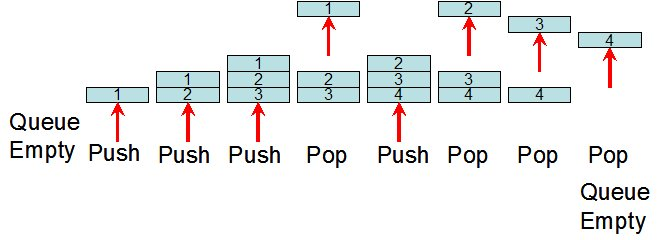
Ordered collection of items: add new items at "rear", remove old items at "front". The item that has been in the collection the longest is at the front - FIFO (as a line in a store).
class Queue:
    def __init__(self):
        self.items = []

    def isEmpty(self):
        return self.items == []

    # adds new item to rear
    def enqueue(self, item):
        self.items.insert(0,item)

    # removes front item
    def dequeue(self):
        return self.items.pop()

    def size(self):
        return len(self.items)
q = Queue()
print(q.size())
print(q.isEmpty())
q.enqueue(1)
print(q.dequeue())
Dequeue
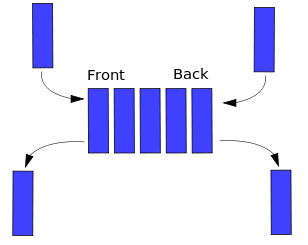
Double Ended Queue provides capabilities of stacks and queues in a single data structure: insert and delete at both ends + no LIFO or FIFO requirements
class Deque:
    def __init__(self):
        self.items = []

    def isEmpty(self):
        return self.items == []

    # add new item to front
    def addFront(self, item):
        self.items.append(item)

    # add new item to rear
    def addRear(self, item):
        self.items.insert(0,item)

    # remove front item
    def removeFront(self):
        return self.items.pop()

    # removes rear item
    def removeRear(self):
        return self.items.pop(0)

    def size(self):
        return len(self.items)
d = Deque()
d.addFront('hello')
d.addRear('world')
print(d.size())
print(d.removeFront() + ' ' +  d.removeRear())
print(d.size())
Stack
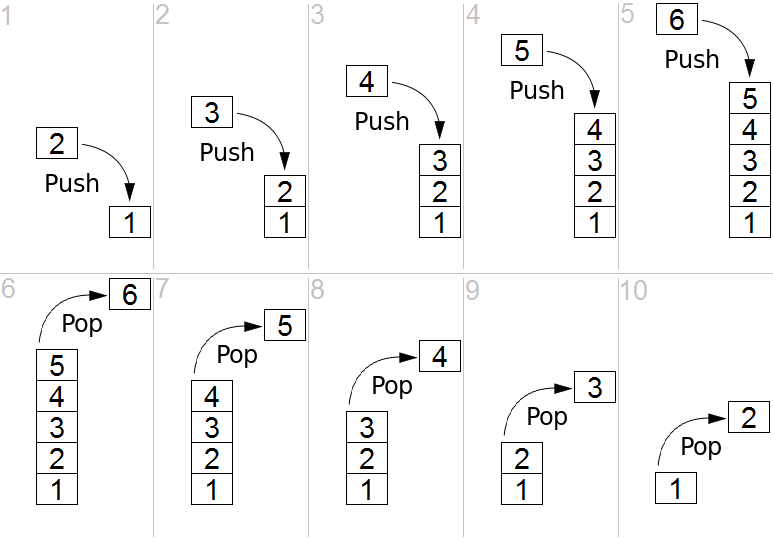
Ordered collection of items added and removed from one end ('top') - LIFO. Newer items are near the top, while older items are near the base. Stacks are fundamental because they can be used to reverse the order of items. Examples: string reversal, the Back button in a browser, etc.
class Stack:

    def __init__(self):
        self.items = []

    def isEmpty(self):
        return self.items == []

    # adds new item to top
    def push(self, item):
        self.items.append(item)

    # remove top item
    def pop(self):
        return self.items.pop()

    # return top item, but do not remove it
    def peek(self):
        return self.items[len(self.items)-1]

    def size(self):
        return len(self.items)
s = Stack()
print s.isEmpty()
s.push(1)
s.push('two')
s.peek()
s.push(True)
s.size()
s.isEmpty()
s.pop()
s.pop()
s.size()
s.pop()
s.isEmpty()
20. Balanced parenthesis check (stack)
A very common interview question * scan string left to right, push every opening parenthesis to stack (last opening parenthesis to be closed first - FILO) * when encounter closing parenthesis, pop last opening p. from stack and see if a match * if yes, proceed, if no False; if stack runs out, and there are still closing p. - False * once all matched - check if stack is empty - True
def balance_check(s):

    if len(s)%2 != 0:                                        # even number of brackets
        return False

    opening = set('([{')                                     # opening brackets

    matches = set([ ('(',')'), ('[',']'), ('{','}') ])       # matching Pairs

    stack = []                                               # list as a "Stack"

    for paren in s:                                          # check every parenthesis

        if paren in opening:
            stack.append(paren)

        else:

            if len(stack) == 0:                              # Are there parentheses in Stack
                return False


            last_open = stack.pop()                          # check last open parenthesis

            if (last_open,paren) not in matches:
                return False

    return len(stack) == 0
to_check = ['[]', '[](){([[[]]])}', '()(){]}']
for i in to_check:
    print(balance_check(i))
Queue with two stacks
"Classic" interview question - use list as Stack * Stack reverses order (LIFO) * Two chained stacks will return elements in the original order * Fill in-stack, dequeue from out-stack * If out-stack empty, pop all elements from in-stack and push them to out-stack
class Queue2Stacks(object):

    def __init__(self):

        self.instack  = []
        self.outstack = []

    def enqueue(self,element):
        self.instack.append(element)

    def dequeue(self):
        if not self.outstack:
            while self.instack:
                self.outstack.append(self.instack.pop())
        return self.outstack.pop()
q = Queue2Stacks()

for i in range(5):
    q.enqueue(i)

for i in range(5):
    print(q.dequeue(), end=' ')
0 1 2 3 4
Stack using two queues
s = stack, q1 & q2 = queues
Method 1 (push costly, implemented below)
Newly entered element is always at the front of q1 => pop dequeues from q1. q2 is used to put every new element at front of q1.
Push: * Enqueue x to q2 * Dequeue all from q1 and enqueue to q2 * Swap names of q1 and q2
Pop: * Dequeue item from q1
Method 2 (pop costly) In push, new elem is enqueued to q1. In pop, if q2 empty => move all elems except last to q2 => the last elem is dequeued from q1.
Push: * Enqueue x to q1
Pop: * Dequeue all but one from q1 and enqueue to q2 * Dequeue last item of q1, store it * Swap names q1 and q2 * Return item stored in step 2
from queue import Queue

class Stack:

    def __init__(self):

        # two queues
        self.q1 = Queue()
        self.q2 = Queue()

        # current size
        self.curr_size = 0

    def push(self, x):
        self.curr_size += 1

        # push x first in empty q2
        self.q2.put(x)

        # push all elems in q1 to q2.
        while (not self.q1.empty()):
            self.q2.put(self.q1.queue[0])
            self.q1.get()

        # swap names
        self.q = self.q1
        self.q1 = self.q2
        self.q2 = self.q

    def pop(self):

        # if no elements are there in q1
        if (self.q1.empty()):
            return
        self.q1.get()
        self.curr_size -= 1

    def top(self):
        if (self.q1.empty()):
            return -1
        return self.q1.queue[0]

    def size(self):
        return self.curr_size


s = Stack()
s.push(1)
s.push(2)
s.push(3)

print("current size: ", s.size())
print(s.top())
s.pop()
print(s.top())
s.pop()
print(s.top())

print("current size: ", s.size())
Two stacks in an array (space efficient)
Start two stacks from opposite ends of arr[]. stack1 starts from the leftmost element, the first element in stack1 is pushed at index 0. The stack2 starts from the rightmost corner, the first element in stack2 is pushed at index (n-1). Both stacks grow (or shrink) in opposite direction. To check for overflow - check for space between top elements of both stacks (see code below)
Time c. for push and pop O(1)
Space c. O(N)
class twoStacks:

    def __init__(self, n):
        self.size = n
        self.arr = [None] * n
        self.top1 = -1
        self.top2 = self.size

    # push element to stack1
    def push1(self, x):

        # There is at least one empty space for new element
        if self.top1 < self.top2 - 1 :
            self.top1 = self.top1 + 1
            self.arr[self.top1] = x

        else:
            print("Stack Overflow ")
            exit(1)

    #  push element to stack2
    def push2(self, x):

        # There is at least one empty space for new element
        if self.top1 < self.top2 - 1:
            self.top2 = self.top2 - 1
            self.arr[self.top2] = x

        else :
           print("Stack Overflow ")
           exit(1)

    # pop element from stack1
    def pop1(self):
        if self.top1 >= 0:
            x = self.arr[self.top1]
            self.top1 = self.top1 -1
            return x
        else:
            print("Stack Underflow ")
            exit(1)

    # pop element from stack2
    def pop2(self):
        if self.top2 < self.size:
            x = self.arr[self.top2]
            self.top2 = self.top2 + 1
            return x
        else:
            print("Stack Underflow ")
            exit()

# Driver program to test twoStacks class
ts = twoStacks(5)
ts.push1(5)
ts.push2(10)
ts.push2(15)
ts.push1(11)
ts.push2(7)

print('Popped element from stack1 is ' + str(ts.pop1()))
ts.push2(40)
print('Popped element from stack2 is ' + str(ts.pop2()))
Next Greater Element with Stack Implementation ((O(n))
Print the Next Greater Element (NGE) for every element of array (-1 if no NGE). NGE - the first greater element on the right side
- Push first elem to stack
- Pick remaining elems in this loop:
- Mark current elem as next.
- If stack not empty, compare next with top elem in stack
- If next > top elem, pop top elem from stack => next is NGE for the popped elem
- Else: keep popping from stack while the popped elem < next => next is NGE for all such popped elems
- Finally, push the next into stack
- After the loop, pop all the elems from stack and print -1.
# simple solution, O(n^2)
def printNGE(arr):

    for i in range(0, len(arr), 1):

        next = -1
        for j in range(i+1, len(arr), 1):
            if arr[i] < arr[j]:
                next = arr[j]
                break

        print(str(arr[i]) + " : " + str(next))


arr = [11,14,21,3]
printNGE(arr)
# using stack, O(n)
def createStack():
    stack = []
    return stack

def isEmpty(stack):
    return len(stack) == 0

def push(stack, x):
    stack.append(x)

def pop(stack):
    if isEmpty(stack):
        print("Error : stack underflow")
    else:
        return stack.pop()


def printNGE(arr):

    s = createStack()
    push(s, arr[0])                                                                   # push first elem

    for i in range(1, len(arr)):                                                      # iterate for remaining

        next = arr[i]
        if not isEmpty(s):

            element = pop(s)                                                          # if stack not empty, pop elem from stack

            '''If popped elem < next, print the pair &
               keep popping while elems < next'''

            while element < next :
                print(str(element)+ " :  " + str(next))
                if isEmpty(s):
                    break
                element = pop(s)

            if  element > next:                                                       # if elem > next, push it back
                push(s, element)

        push(s, next)                                                                 # push next to stack to find NGE for it

    while not isEmpty(s):                                        # after the loop, the remaining elements in stack have no NGE
            element = pop(s)
            next = -1
            print(str(element) + " : " + str(next))


arr = [11, 14, 21, 3]
printNGE(arr)
11 :  14
14 :  21
3 : -1
21 : -1
Bitwise operators
# BINARY REPRESENTATION
def convert_tobin(n):
    '''
       Convert any number, but 0. Remainder from division by 2 is either 0 or 1 - keep adding them from right to left
       as the first remainder is the least significant bit (LSB) on the right, and the last remainder will be the most
       significant bit on the right
    '''
    if n==0: return ''
    else:
        return binary(n//2) + str(n%2)

def binary(m):
    '''Convert 0; if not 0, use convert_tobin()'''
    if m==0: return '0'
    else:
        return convert_tobin(m)

print('Decimal  |  Binary')
for i in range(15):
    print('  {}           {}'.format(i, binary(i)))
Decimal  |  Binary
  0           0
  1           01
  2           010
  3           011
  4           0100
  5           0101
  6           0110
  7           0111
  8           01000
  9           01001
  10           01010
  11           01011
  12           01100
  13           01101
  14           01110
RATIONALE
Convert decimal to binary (the leftmost MSB is at the bottom) and the result is '100100110':
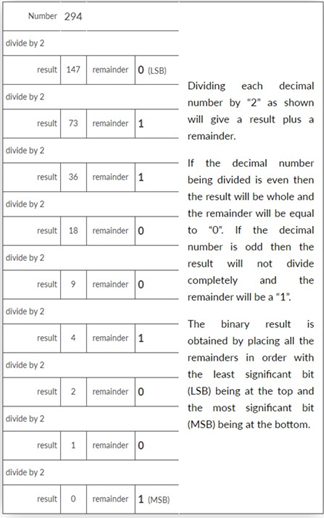
Back to decimal: 2**n + 2**(n-1) + 2**(n-2) ... + 2**0 for set bits only (for "1")
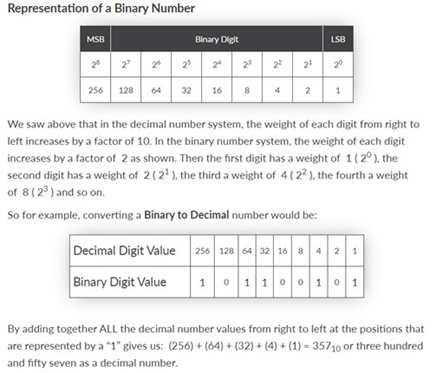
For example from the first picture: 2**8 + 2**5 + 2**2 + 2**1 = 294
XOR
"Exclusive or" compares two binary numbers bitwise: both bits the same => 0, if not => 1. Example: 6^3=5 i.e. 110^011=101. For booleans: True=1, False=0 True^False=True. Outputs integer for integers and bollean for booleans. Decimals: 9^0=9, 9^9=0 (the same), 9^9^5=5 - useful for finding a missing value in one of the two arrays
# FIND A MISSING NUMBER
arr1 = [1,2,3,4,5]
arr2 = [1,2,4,5]
res = 0
for i in arr1+arr2:
    res ^= i
print(res)
# FIND A DIFFERENT NUMBER
arr = [5,5,5,4,5]
res = 0
for i in arr:
    res ^= i
print(res)
'100100110'
Other bitwise operators
a = 60            # 60 = 0011 1100
b = 14            # 13 = 0000 1110

c = a & b;        # 12 = 0000 1100                      # 0=False, 1=True => False & True = False
print("Line 1 - Value of c is ", c)

c = a | b;        # 62 = 0011 1110                      # False or True = True
print("Line 2 - Value of c is ", c)

c = a ^ b;        # 49 = 0011 0010
print("Line 3 - Value of c is ", c)

c = ~a;           # -61 = 1100 0011                     # not - reverse bit
print("Line 4 - Value of c is ", c)

# The left operand's value is moved left by the number of bits specified by the right operand (void filled with 0s)
c = a << 2;       # 240 = 1111 0000
print("Line 5 - Value of c is ", c, ' : ', bin(c))

# same as above, but to the right
c = a >> 2;       # 15 = 0000 1111
print("Line 6 - Value of c is ", c)
Definition: 1 = set bit, 0 = clear bit.To find if the Nth bit of an integer is set, use a shift operation to check the value of only that one specific bit
# Count number of bits to be flipped to convert A into B

# Function that count set bits
def countSetBits( n ):
    count = 0
    while n:
        count += 1
        n &= (n-1)
    return count

# Function that return count of flipped number
def flippedCount(a , b):

    # Return count of set bits in a XOR b
    return countSetBits(a^b)

a = 10
b = 20
print(flippedCount(a, b))
Number Theory (Geeksforgeeks)
Primality check
School Method: iterate from 2 to n-1, for every number check if it divides n. Time c. O(n)
Optimizations:
* Iterate only up until sqrt(n) - larger factor of n must be multiple of smaller factor
* Check only 6k ± 1 and 2 & 3 (this covers all primes). All integers can be expressed as (6k + i) for some integer k and for i = -1, 0, 1, 2, 3, or 4; 2 divides (6k + 0), (6k + 2), (6k + 4); and 3 divides (6k + 3)
def isPrime(n) :

    if (n <= 1): # Corner cases
        return False
    if (n <= 3) :
        return True

    if (n % 2 == 0 or n % 3 == 0) :
        return False

    i = 5
    while(i * i <= n) :
        if (n % i == 0 or n % (i + 2) == 0) :
            return False
        i = i + 6

    return True


print('Prime or not?')
print('11:', isPrime(11))
print('15:', isPrime(15))
print('23:', isPrime(23))
print('25:', isPrime(25))
print('27:', isPrime(27))
Appendix (disregard)
Reverse a Linked List in groups of given size | Set 1
Given a linked list, write a function to reverse every k nodes (where k is an input to the function).
Example:
Input: 1->2->3->4->5->6->7->8->NULL, K = 3
Output: 3->2->1->6->5->4->8->7->NULL
Input: 1->2->3->4->5->6->7->8->NULL, K = 5
Output: 5->4->3->2->1->8->7->6->NULL
Version 1 - using reverse(LL) function for every k elems
Time c. O(n), space c. O(1)
Version 2 - using stack
Space c. O(k)
* push the k elements of LL to stack
* pop elems one by one, keep track of prev popped node; point next pointer of prev node to top elem of stack;
* reptead until NULL (end of LL)
# Node class
class Node(object):

    def __init__(self, data = None, next = None):
        self.data = data
        self.next = next

    def __repr__(self):
        return repr(self.data)

class LinkedList(object):

    # initialize head
    def __init__(self):
        self.head = None

    # print nodes of LL
    def __repr__(self):
        nodes = []
        curr = self.head
        while curr:
            nodes.append(repr(curr))
            curr = curr.next
        return '[' + ', '.join(nodes) + ']'

    # insert a new node at beginning
    def prepend(self, data):
        self.head = Node(data = data,
                         next = self.head)

    # reverse LL in groups of size k, return pointer to new head
    def reverse(self, k = 1):
        if self.head is None:
            return

        curr = self.head
        prev = None
        new_stack = []
        while curr is not None:
            val = 0

            while curr is not None and val < k:
                new_stack.append(curr.data)
                curr = curr.next
                val += 1

            # pop elems of stack one by one
            while new_stack:

                # if final list has not been started yet.
                if prev is None:
                    prev = Node(new_stack.pop())
                    self.head = prev
                else:
                    prev.next = Node(new_stack.pop())
                    prev = prev.next

        # next of last elem points to None
        prev.next = None
        return self.head


LL = LinkedList()
LL.prepend(9)
LL.prepend(8)
LL.prepend(7)
LL.prepend(6)
LL.prepend(5)
LL.prepend(4)
LL.prepend(3)
LL.prepend(2)
LL.prepend(1)

print('Given LL:')
print(LL)
LL.head = LL.reverse(3)

print('\nReversed LL:')
print(LL)
Given LL:
[1, 2, 3, 4, 5, 6, 7, 8, 9]

Reversed LL:
[3, 2, 1, 6, 5, 4, 9, 8, 7]